

Ring Battery Doorbell 2K Plus vs Nest Doorbell Battery Life: Real-World Data (2026)
AbodeAlly is reader-supported. When you buy through links on this page, we may earn an affiliate commission — it never changes our picks, and you never pay extra.
“Up to 6 months” on the box means very different things for Ring and Nest. Ring refreshed its battery lineup in March 2026, and the Plus that most comparison tables still cite (1536p, up-to-8-month claim) is a discontinued generation. Here’s what the batteries actually deliver on the current hardware, why Nest’s drains faster in winter, and which doorbell survives your porch.
Published 28 September 2026 · Updated 28 September 2026
Key Takeaways
- Ring Battery Doorbell 2K Plus wins on battery logistics: swappable pack means zero downtime, ~2–3 months per charge.
- Nest Doorbell (battery) lasts ~2.5 months typical but can’t charge below 32°F — cold climates should avoid it.
- Real-world battery life is half the “up to 6 months” claim for both; high-traffic porches drain faster.
- For Google Home households, Nest’s integration may outweigh the battery hassle; everyone else should pick Ring.
The 60-second verdict
| Your scenario | Winner | Why |
|---|---|---|
| Longest time between charges | Ring Battery Doorbell 2K Plus | No official Ring battery figure (owners report ~2–3 months depending on activity) vs Nest’s ~2.5-month target; real-world estimates land around 2–3 months for the Ring, ~2 months for the Nest |
| Cold climate (freezing winters) | Ring | Swappable battery you charge indoors; Nest can’t charge below 32°F |
| High-traffic porch | Ring | Spare battery = zero downtime when the charge runs out |
| Google Home household | Nest Doorbell (battery) | Native Google Home + on-device AI; accept the charging tradeoff |
| Alexa household | Ring | Native Alexa announcements and routines |
| Hate maintenance | Ring | Quick-release battery swaps in under 5 minutes |
Bottom line: On the current hardware, Ring’s edge is narrower than the old generation’s “5–6 months vs 2 months” story — Ring publishes no official battery figure for the 2K Plus, and owners report ~2–3 months depending on activity, only slightly ahead of Nest’s ~2.5-month target. Ring still wins where it counts structurally: capacity (2K sensor notwithstanding), swappability, and cold-weather behavior. Buy the Nest only if you’re committed to Google Home and live somewhere mild.
Note on naming: Ring has renamed the “Battery Doorbell Plus (2nd Gen)” to the “Battery Doorbell 2K Plus.” Same device, new name — we’ve used the current name throughout.
Head-to-head: battery specs
| Spec | Ring Battery Doorbell 2K Plus | Google Nest Doorbell (battery) |
|---|---|---|
| Resolution | Retinal 2K (1920×1920) head-to-toe | 960×1280 head-to-toe (3:4) |
| Claimed battery life | No published figure (Ring); owners report ~2–3 months depending on activity | ~2.5 months typical; up to 6 in very quiet locations |
| Real-world battery life | ~2–3 months (estimated — limited independent data for this new model) | ~2 months (independent test) |
| Battery design | Quick-release pack — swap spares, no downtime | Built-in — unmount the whole doorbell to charge |
| Recharge method | Micro-USB cable (included); optional solar panel | USB cable (7.5 W charger not included); ~5 hrs 0–100% |
| Operating range | −4°F to 122°F (−20°C to 50°C) | −4°F to 104°F (−20°C to 40°C) |
| Charging below freezing | Stops charging below 32°F/0°C (charge the spare indoors) | Will not charge below 32°F/0°C — even when wired |
| Night vision | Color low-light sight; adaptive B&W in darkness | Infrared (black & white) |
| Wi-Fi | WiFi 6, dual-band 2.4/5 GHz | 2.4 GHz only |
| Price | $179.99 MSRP | $199.99 (was $179.99 before Google’s Aug 31, 2026 hardware price hike) |
| Check price |
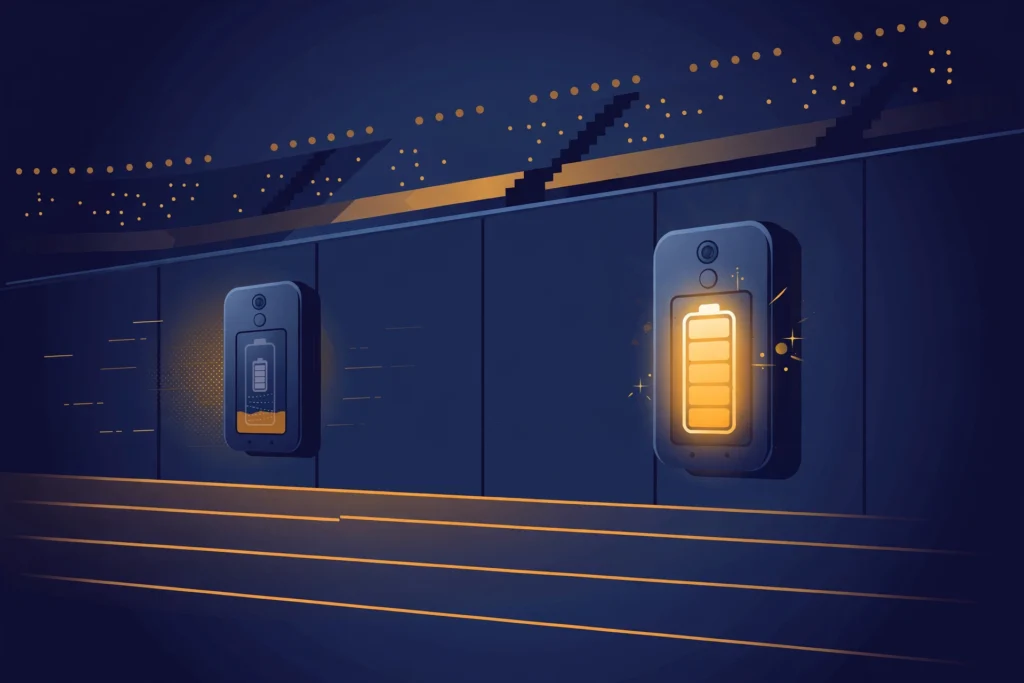
Sources: ring.com official tech specs (2K Retinal, dual-band WiFi 6, −4°F–122°F range); TechRadar Ring Battery Video Doorbell Plus (2nd Gen) review (Retinal 2K 1920×1920, 6x zoom); smarthomegearreviews.com 30-day real-world comparison (Sep 2026 — Nest ~2 months; the ~5-month Ring figure in that test was the discontinued first-gen Plus); Google Nest support (charging thresholds); iCameraPlus 2026 cold-weather roundup (Ring/Nest/Arlo official limits).
A warning about old comparisons: many ranking pages still cite the 2023 first-gen Battery Doorbell Plus (1536p, “up to 8 months” claim). That hardware is discontinued. Ring publishes no official battery figure for the current 2K Plus (owners report ~2–3 months depending on activity) — still ahead of the Nest on average, but not the 8-month headline the old reviews quote.
Why the Nest battery dies faster: the cold-weather problem
This is the single biggest real-world difference, and it comes down to lithium-ion chemistry plus one design decision by Google.
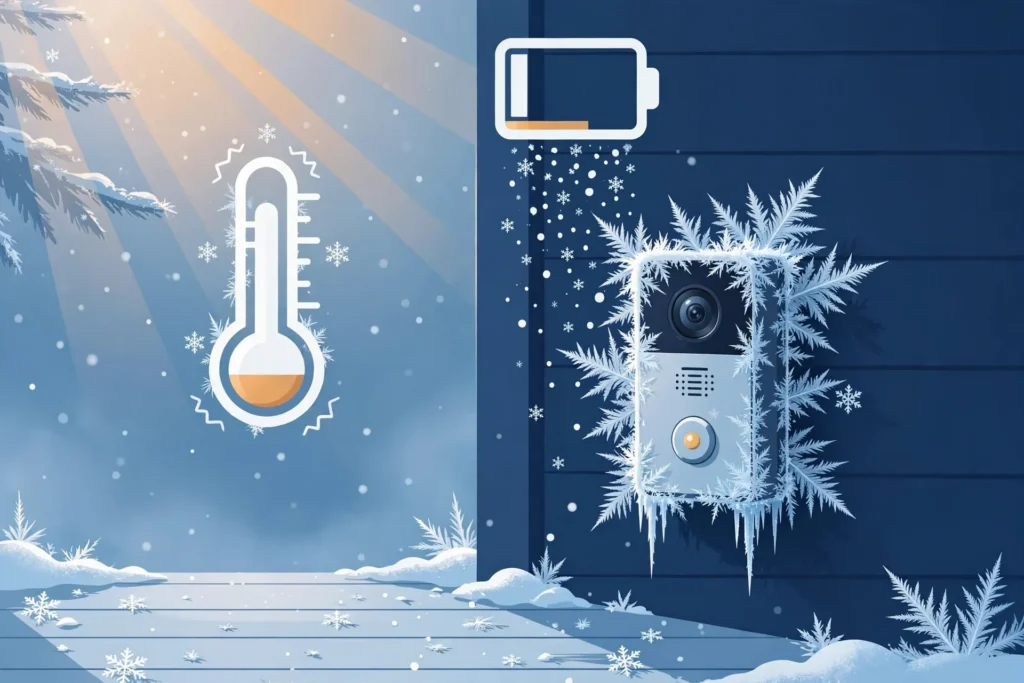
Nearly every battery doorbell stops charging in the cold. Ring, Nest, and Arlo all document the same limit: below about 32°F (0°C), the battery won’t accept a charge — this protects the cell from damage. The camera keeps running on its existing charge, draining faster than usual, until it’s empty.
Nest is hit hardest, for two reasons:
- The Nest Doorbell (battery) trickle-charges even when wired. Unlike a true wired doorbell, a wired Nest still runs on its internal battery, topped up by the wiring. Below 32°F the trickle charge stops, the battery drains, and the doorbell eventually shuts off — even though it’s wired. Google’s own support page says to bring the whole unit inside to a warm place to charge.
- Near −4°F, Google says the battery may deliver less than half its warm-weather life. Combine that with no swappable battery, and a cold-climate Nest owner can face days of downtime mid-winter — exactly when the house is darkest and emptiest.
Ring’s advantage isn’t chemistry — it’s the removable battery. Ring stops charging below freezing too. But you pull the Quick Release pack, charge it indoors, and slot it back in under five minutes. Add Ring’s optional solar panel and many owners rarely charge manually at all.
If you live where winters regularly drop below freezing, this section alone should decide it: Ring.
What actually drains a doorbell battery
Manufacturer “up to X months” figures assume a quiet suburban door with a handful of events per day. Your mileage depends on:
| Drain factor | Effect | What to do |
|---|---|---|
| Event frequency | A busy street-facing porch can cut battery life in half | Tighten activity zones; lower motion sensitivity |
| Live-view sessions | Frequent live viewing drains far faster than standby — check clips, not live streams | Keep sessions short |
| Two-way talk duration | Speaker + mic + radio is the hungriest combo | Keep conversations short |
| Cold weather | Capacity drops; charging pauses below 32°F | Ring: swap batteries; Nest: wired won’t save you |
| Weak Wi-Fi | Radio works harder to stay connected | Add a chime/extender near the door; use 5 GHz if available (Ring) |
| Night vision mode | IR LEDs draw power all night | Color night vision (Ring) uses ambient light more efficiently |
| Snapshot capture | Periodic stills between events add up | Disable if you don’t need them |
As a rough rule of thumb (our heuristic, not lab science): take the manufacturer’s claim, then subtract 30–50% for a normal porch, and another chunk for winter. Note the evidence limits: the independent 30-day test that ran both side by side covered the previous-generation Ring Plus — it estimated ~5 months for that model (the same site’s Dec 2025 roundup reported 3.5 months for it), and ~2 months for the Nest. Those figures don’t transfer to the new 2nd Gen, which is too new for long independent charge-cycle data — treat the ~2–3 month real-world range above as an estimate, not a measurement.
Verdicts by scenario
Cold climate (Upper Midwest, Northeast, Canada): Ring, no contest. Swappable batteries beat a sealed unit that refuses to charge below freezing. Wire it if you can, but keep a charged spare in a drawer from November to March.
High-traffic porch (apartments, busy streets): Ring. More events per charge, and when it does die, the swap takes minutes — not the hours the Nest spends on a charger while your door is unwatched.
Google Home household: Nest — with eyes open. If your home runs on Google Home, Pixel phones, and Nest Hubs, the Nest Doorbell’s native integration and on-device person/package/vehicle/familiar-face detection are genuinely good. Just know you’re buying a ~2-month charging cadence and a winter weakness. If you have doorbell wiring, consider the wired Nest Doorbell (2nd gen) instead — it runs on continuous power and skips the battery entirely.
Alexa household: Ring. Doorbell press announcements on every Echo, routines, and the Ring app is one of the most mature in the business.
Renters: Ring. Battery power + adhesive/no-drill mounting options + swappable battery = the lowest-friction doorbell you can install without touching wiring. See our no-wiring install guide.
Pros
- Swappable Quick Release battery pack — zero downtime with a spare
- ~2–3 months per charge; charge the spare indoors in winter
Cons
- No official battery figure from Ring; limited independent data for this new model
- Higher $179.99 MSRP than the base Ring 2K ($99.99)
Pros
- Native Google Home integration with on-device AI (person/package/animal detection)
- 3:4 head-to-toe view shows packages at the doorstep
Cons
- Built-in battery — unmount the whole doorbell to charge (~5 hours downtime)
- Won’t charge below 32°F; cold climates face multi-day outages
A note on Ring’s 2026 lineup
Ring refreshed its battery lineup in March 2026 and has since renamed the models: the “Battery Doorbell Plus (2nd Gen)” became the Battery Doorbell 2K Plus ($179.99 MSRP). The lineup now runs: Battery Doorbell 2K ($99.99) below the Plus, and a 4K Pro model topping the range. The battery-life logic in this article applies across the lineup — removable batteries and the same cold-weather behavior — but charge-cycle figures above are for the 2K Plus specifically.
Charging logistics: the hidden cost of battery life
Specs aside, here’s what ownership feels like over a year:
| Ring Battery Doorbell 2K Plus | Nest Doorbell (battery) | |
|---|---|---|
| Charges per year (typical porch) | ~4–6 | ~5–6 |
| Downtime per charge | ~0 min (swap spare pack) | ~5 hours (whole unit on a cable) |
| Winter behavior | Swap in a warm spare | “Charging paused” below 32°F; may need indoor charging |
| Annual maintenance time | ~20 minutes | ~25–30 hours of unmonitored door |

Four to six quick swaps a year with zero downtime versus five or six charges with hours of downtime each — that’s the real gap between these two batteries. It matters more than any spec-sheet number.
FAQ
How long does the Ring Battery Doorbell 2K Plus battery last?
Ring publishes no official battery figure for the 2K Plus. On a typical porch, owners report roughly 2–3 months depending on activity — the model is new enough (March 2026) that long-term independent charge-cycle data is still limited, so treat that range as an estimate. Note: old reviews quoting “up to 8 months” describe the discontinued first-generation Plus, not this model.
How long does the Nest Doorbell battery last?
Google’s design target is around 2.5 months, with up to 6 months in very quiet locations. Real-world tests land near 2 months for a typical porch.
Can you replace the Nest Doorbell battery?
No — it’s built in. You unmount the entire doorbell and charge it via USB (about 5 hours for a full charge), leaving your door unmonitored in the meantime.
Why does my Nest Doorbell say “charging paused” in winter?
Below 32°F (0°C), lithium-ion batteries can’t safely accept a charge, so the doorbell pauses charging until it warms up. This applies even if the doorbell is wired, because wired Nest doorbells only trickle-charge the internal battery.
Does cold weather affect the Ring doorbell too?
Yes — Ring also stops charging below freezing. The difference is you can swap in a warm, charged spare battery instead of taking the whole doorbell down.
Sources
- https://ring.com/products/battery-doorbell-plus-2nd-gen — official tech specs (Retinal 2K, dual-band WiFi 6, −4°F–122°F range; product page now lists the renamed “Battery Doorbell 2K Plus”)
- https://www.techradar.com/home/home-security/ring-battery-video-doorbell-plus-2nd-gen-review — 2nd Gen review (Retinal 2K 1920×1920, 6x zoom)
- https://smarthomegearreviews.com/comparisons/ring-battery-doorbell-plus-vs-google-nest-doorbell-comparison/ — 30-day real-world comparison (Sep 2026 — Nest ~2 months; Ring figures in this test are the discontinued first-gen Plus)
- https://www.digitaltrends.com/home/nest-doorbell-vs-ring-battery-doorbell-plus/ — comparison covering the previous-generation Ring Plus (specs and claims there are stale)
- https://icameraplus.com/blog/does-cold-weather-kill-security-camera-battery — 2026 cold-weather limits (Ring/Nest/Arlo)
- https://www.bestbuy.com — Ring Battery Doorbell 2K owner review (120-day charge cycle)
Your next step
- Eufy vs Arlo Video Doorbell (2026): Models, Subscription Math, and the Real Winner — Compare the other big doorbell rivalry on subscription value.
- How to Install a Video Doorbell Without Existing Doorbell Wiring (2026) — Battery-powered? Make sure the wire-free install is done right.
- Can You Use a Ring Doorbell Without a Subscription? (2026) — Check what Ring gives you without paying monthly.
Recent updates
- 28 September 2026 — Restructured with Key Takeaways, pros/cons boxes and FAQ schema; re-verified specs and prices.
Why you can trust AbodeAlly
AbodeAlly is a research-based buying guide, not a test lab. We don’t run a warehouse of gadgets or a lab bench, so we never invent hands-on test results.
Every pick starts with manufacturer specifications and standards documents, cross-checked against reputable expert reviews and long-term owner feedback. We re-verify specs and prices on a regular update cadence, and each article carries a dated changelog so you can see exactly what changed and when.
Spot an error or an out-of-date price? Tell us and we’ll fix it — corrections are published openly, not buried.


4 Comments