Aliro and UWB Smart Locks, Explained (2026): What ULTRALOQ’s New Lineup Changes at Your Front Door
Aliro is a new open standard that lets your phone’s wallet app (Apple Wallet, Google Wallet, Samsung Wallet) act as your house key — no lock-brand app, no cloud, no subscription. UWB (ultra-wideband) is the radio tech that makes locks hands-free: it measures your distance to the door in centimeters, so the lock knows you’re walking up to it, not just nearby. On September 26, 2026, ULTRALOQ launched the first lock lineup built on both: the Bolt Mission (first UWB-enabled smart lock, $299.99), Bolt Pro ($269.99), and Latch 5 Pro ($249.99).
This is launch coverage, not a hands-on review — no independent reviewer has tested the shipping units as of 2026-09-30. Every spec below is attributed to ULTRALOQ’s announcement or named press, and where sources hedge, we say so.
Key Takeaways
- Aliro 1.0 (released Feb 2026 by the Connectivity Standards Alliance) is a cross-platform digital-key standard: one key standard for iPhone and Android, Apple/Google/Samsung wallets. It works offline — no app, no cloud, no account required. (For how today’s locks handle offline and internet-outage scenarios, see whether smart locks work without Wi-Fi
- ULTRALOQ’s Bolt Mission is the industry’s first UWB-enabled smart lock: it unlocks as you approach, using BLE + UWB ranging + radar presence sensing to tell “arriving from outside” apart from “moving around inside.”
- Bolt Pro ($269.99) and Latch 5 Pro ($249.99) are the first multi-model line of Aliro-certified locks — tap-to-unlock with a wallet key, plus fingerprint, PIN, app, and physical key.
- All three are Matter-certified and work with Apple Home and Google Home; Bolt Pro and Latch 5 Pro also integrate with Samsung SmartThings.
- The honest catches: ULTRALOQ hadn’t confirmed which phones support the UWB feature at launch; the wallet list named Apple and Samsung but not Google; and nobody has independently tested the shipping locks yet.
Disclosure: This article currently contains no affiliate links — we’re covering this launch on editorial merit. If that changes, we’ll say so.
What Aliro actually is
Aliro is to keys what Matter is to devices — both come from the Connectivity Standards Alliance, but where Matter defines how devices are controlled, Aliro defines how a digital credential in your phone’s wallet talks to a lock. Announced in November 2023 and released as Aliro 1.0 in February 2026, it’s built on IP from seven founding companies (Apple, ASSA ABLOY, Google, Infineon, Last Lock, Samsung, STMicroelectronics) with 220+ CSA member companies contributing.
The architecture is the important part: your phone connects directly to the lock. The digital key lives in your wallet’s secure enclave, the exchange uses asymmetric cryptography, and no cloud server sits in the middle. If you’ve used Apple’s Home Key, you’ve seen the mechanic — the difference is that Aliro is cross-platform, so an iPhone owner and an Android owner don’t need different locks. Secure key sharing (temporary guest keys, service-provider access) is on the CSA’s roadmap.
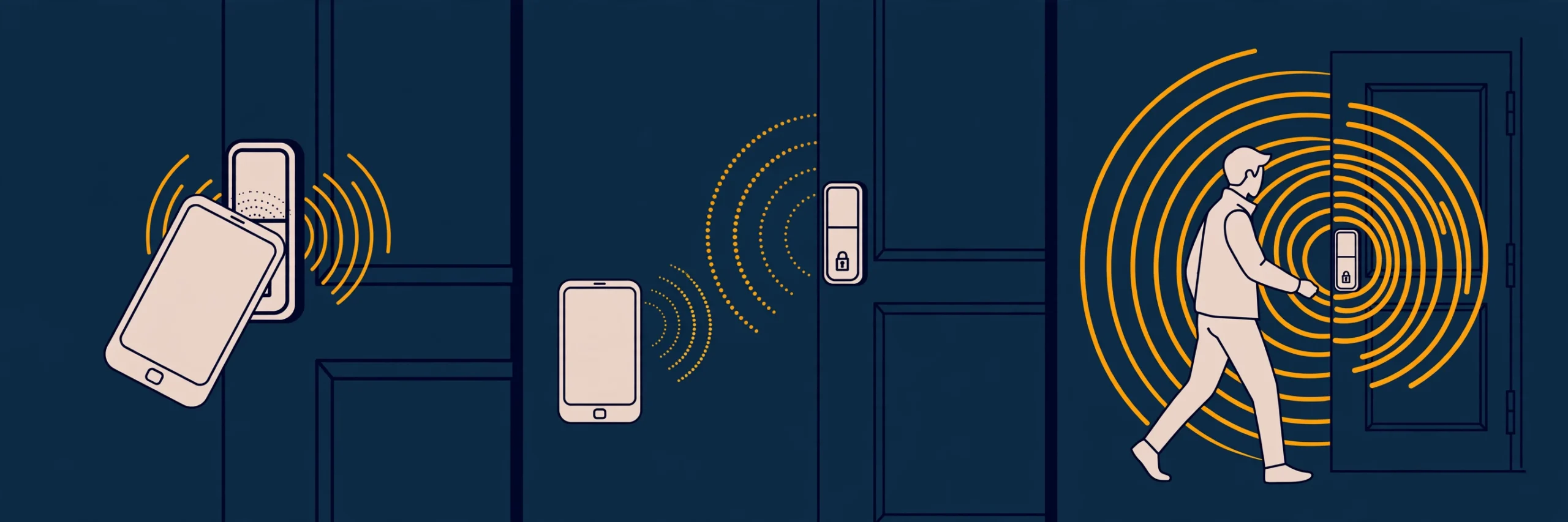
Aliro supports three radio modes, matched to how hands-free you want entry to be:
| Aliro mode | How you unlock | What it feels like |
|---|---|---|
| NFC | Tap phone to the lock | Contactless payment, but for your door |
| Bluetooth LE | Initiate from a few feet away | Remote unlock, no touching the lock |
| BLE + UWB | Walk up; the door unlocks itself | Fully hands-free, intent-aware entry |

What UWB adds that Bluetooth couldn’t
Bluetooth auto-unlock exists on older locks, and its flaw is well known: the geofence is crude, so locks unlock when you’re still in the driveway — or relock badly when you walk past the door inside the house. UWB (ultra-wideband) measures distance by timing radio pulses to centimeter precision. Combined with radar-based presence sensing and local decision logic, the Bolt Mission claims to answer the harder question: is this person approaching the door from outside, or moving around inside the home? That intent-awareness is what makes hands-free unlock trustworthy rather than a party trick. The same tech already lives in modern phones for digital car keys and item trackers — the lock world is just catching up.

The ULTRALOQ lineup: three locks, three entry styles
ULTRALOQ (a brand of IoT company Xthings) announced the collection on September 26, 2026. “The front door is moving away from keys and apps toward digital credentials and intent-aware access,” said Raj Sundar, ULTRALOQ’s senior director of product management. Prices below are from launch coverage; availability is Home Depot online from October 2026, plus ULTRALOQ’s own site and Amazon.
| Bolt Mission | Bolt Pro | Latch 5 Pro | |
|---|---|---|---|
| Price (MSRP) | $299.99 | $269.99 | $249.99 |
| Door type | Deadbolt | Deadbolt | Lever (side doors, offices, garages) |
| Headline feature | Hands-free UWB approach unlock | Aliro wallet key + everything else | Aliro wallet key for lever doors |
| Aliro-certified | — | Yes | Yes |
| UWB | Yes (first UWB lock) | — | — |
| Access methods | UWB hands-free, app, NFC, PIN, physical key | Wallet key, fingerprint, PIN, app, physical key | Wallet key, fingerprint, PIN |
| Matter | Certified | Certified | Certified |
| Ecosystems | Apple Home, Google Home | Apple Home, Google Home, SmartThings | Apple Home, Google Home, SmartThings |
Bolt Mission: the hands-free one
The flagship. ULTRALOQ positions the Bolt Mission as the industry’s first ultra-wideband-enabled smart lock: BLE discovers your phone, UWB ranging tracks your approach with centimeter precision, radar confirms presence, and local processing decides you’re arriving from outside — then the deadbolt retracts as you walk up, phone still in your pocket. No tap, no fingerprint, no PIN.
The catch that matters most: ULTRALOQ had not said which phones support the UWB feature at launch (TalkAndroid, ~Sept 25). UWB needs a UWB chip in your phone — most recent flagships have one, but it’s not universal. CES 2026-era reporting on the Bolt Mission also noted that its UWB worked only through the ULTRALOQ app and that it did not support Apple Home Key (MacRumors, Jan 2026) — that predates this collection launch, so treat it as history that may or may not still apply, and verify at the product page before buying.
Bolt Pro and Latch 5 Pro: the wallet-key ones
These are the first multi-model line of Aliro-certified smart locks — the practical, deliberately-confirmed way to open a door. The Bolt Pro deadbolt takes an Aliro wallet key plus fingerprint, PIN, app control, and a physical key; the Latch 5 Pro brings the same wallet-key idea to lever-style doors (side entrances, garages, home offices, shared spaces), with fingerprint and PIN alongside. Both feed lock activity into Samsung SmartThings, so unlocking can trigger lighting or thermostat automations.
One nuance worth flagging: Aliro as a standard supports Apple, Google, and Samsung wallets — but ULTRALOQ’s launch communications named Apple Wallet and Samsung Wallet only. Google Wallet isn’t confirmed for these specific locks yet. If you’re on a Pixel, that’s the line to watch.

Why this matters even if you never buy a ULTRALOQ
Aliro is a durable standards shift, not a news spike. Aqara and Nuki were already lining up Aliro-compatible hardware around the 1.0 release, and the standard will only spread across more brands — which is exactly why an explainer like this ages well. For context on the ecosystem these locks plug into, see our Matter explainer. If you’re shopping locks today rather than waiting, our smart-lock install guide and no-subscription security hub cover what’s actually shipping and working now. They also integrate with Apple Home — see how Apple’s platform compares to the Matter standard.
For a security reality check, see Pwn2Own’s smart home hacking contest.
Who should buy which
Bolt Mission, if…
- You want the door to unlock as you walk up, with no tap, PIN, or fingerprint.
- Your phone has a UWB chip and you’re comfortable confirming compatibility first.
- You trust local intent-detection over a cloud geofence.
Bolt Pro, if…
- You want the most ways in: wallet key, fingerprint, PIN, app, physical key.
- Your household mixes iPhone and Samsung phones — one standard covers both.
- You use SmartThings automations tied to lock activity.
Latch 5 Pro, if…
- The door takes a lever, not a deadbolt — side doors, garages, offices.
- You want Aliro wallet-key convenience without paying deadbolt prices.
Wait for reviews, if…
- You need confirmed Google Wallet support or a published phone-compatibility list — neither exists yet.
- You never buy generation-one hardware without independent testing. Nothing here has been tested by independent reviewers yet.
Our research method
No independent review of the shipping collection exists yet — we did not test these locks and won’t pretend we did. This article is built from ULTRALOQ’s September 26, 2026 announcement (via PR Newswire), launch coverage from Security Systems News (Sept 25), AndroidGuys, TalkAndroid, HomeCrux, GearBrain, and homekitnews, plus background on the Aliro 1.0 standard from the Connectivity Standards Alliance via SmartHomeDigest, CEPro, and TechGlimmer. Where launch communications leave gaps (phone compatibility, Google Wallet), we say so. Prices re-verified 2026-09-30.
Frequently asked questions
What is an Aliro smart lock?
An Aliro smart lock is one certified to the Connectivity Standards Alliance’s Aliro 1.0 digital-key standard: it accepts a key stored in your phone’s native wallet (Apple, Google, or Samsung Wallet) over NFC, Bluetooth LE, or ultra-wideband — no lock-brand app or cloud account required.
Does an Aliro lock need an app or a subscription?
No. Aliro credentials live in the wallet’s secure enclave and the phone talks to the lock directly over local radio — no app, no cloud, no account, and no subscription. ULTRALOQ’s locks also offer their own app as an option, not a requirement for Aliro tap-to-unlock.
Does the ULTRALOQ Bolt Mission need a UWB phone?
Yes for the hands-free UWB feature — UWB ranging requires a UWB chip in your phone (most recent flagships have one). ULTRALOQ had not published a phone-compatibility list at launch, so confirm before buying. The lock’s other methods (app, NFC, PIN, key) don’t need UWB.
Is the ULTRALOQ Bolt Mission really the first UWB smart lock?
That’s ULTRALOQ’s positioning, and no other shipping consumer lock had UWB at launch time per the coverage we found. ULTRALOQ teased a UWB lock concept as far back as 2024; the Bolt Mission is the shipping product.
When can I buy them?
ULTRALOQ says the collection will be available online through Home Depot beginning in October 2026, alongside ULTRALOQ’s own website and Amazon.
Your next step
If you’re buying a lock today and don’t want to be a generation-one tester, the proven smart-lock guidance still applies — start with what to know before installing a smart lock and the no-subscription security hub. If you’re waiting for the standard to mature, this article will be updated when independent reviews and a phone-compatibility list land.
First published 2026-09-30. Prices and launch details re-verified 2026-09-30. No hands-on review of shipping units exists yet; this article will be updated when independent testing is available.



4 Comments